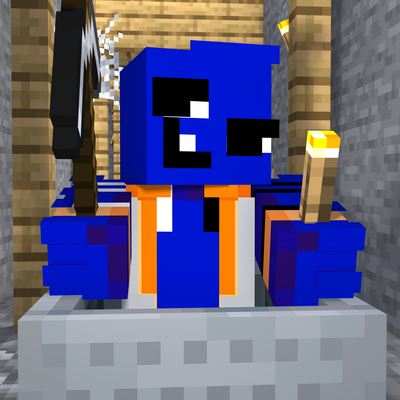
The Trailblazer Cart
It places a rail one block ahead, rides onto it, and repeats, handling one-block slopes up and down and clearing short grass and flowers out of the way. Fuel is charged per rail, not per second: one coal or charcoal per 16 rails placed. Coal in the fuel slot self-propels it at a steady 0.2 blocks per tick, but a cart shoved by a player or coasting downhill lays track for free on momentum. It stops only when it runs out of rails.
Tip: Three placement modes cycle from a button in the cart's GUI: Regular, Greedy (the 3:1 method) and Random.
Gap bridging
The Trailblazer has two extra bridge-material slots that take any block item: cobblestone, planks, dirt, whatever you feed it. When the path ahead is clear but has nothing under it, the cart lays one bridge block at rail level minus one and the rail on top of it in the same tick, exactly the way a player bridges. Bridge blocks displace liquid and cost no coal. Leave the slots empty and the old behaviour returns: it drives straight into the water.
Tip: Bridging covers flat gaps and one-block drops, but not the case where the track needs to climb.
The Evil Trailblazer Cart
The same cart with the opposite job. Drive it down an existing line and it eats the rails back into its own inventory instead of placing them, stopping when it fills up or the track ends. One pass undoes a Trailblazer's work.
Tip: Handy for reclaiming a line you laid in the wrong direction, since the copper comes back to you.
The Tunnel Cart
Give it plain rails, a pickaxe and coal and it bores a tunnel two blocks high and one wide ahead of itself, laying track behind as it goes. It mines everything including ores into four extract-only storage slots, and the pickaxe tier is enforced, so an iron pick will not eat obsidian, and nothing touches bedrock. The tier also sets the speed: netherite and diamond full rate, iron and gold three quarters, stone half, anything else a quarter. It stops when it runs out of rails, loses its pickaxe, or fills its storage.
Tip: It refuels itself on any coal it digs up, and fluids ahead of it are neither mined nor treated as an obstacle.
The Farmer Cart
The only cart that needs no coal; it drives itself as long as it has work to do. It runs existing track and services the ground one block out on both sides. Per rail passed, on each side it harvests a mature crop and replants it, or plants the first seed in its storage on bare farmland, or tills dirt, grass and dirt paths into farmland with its hoe. Harvest drops top its own seed supply back up, so a loop of track becomes a self-tending farm.
Tip: Only true crop blocks are ever planted, so cactus, sugar cane and saplings are excluded by design.
Copper rails oxidise
Rails crafted from copper age like copper blocks, but about twice as slowly, through four stages, and the stage changes how fast carts run on them. Polished copper rail is 25% faster than iron rail, exposed is level with it, weathered is 5% slower and oxidized is 10% slower. Honeycomb waxes a rail to lock its stage, and an axe scrapes wax off or steps the oxidation back.
Tip: Wax the line the day you finish it and it stays at plus 25% forever.
The Maintenance Cart
The railway roomba. Load it with honeycomb and an axe and set it down the line: it scrapes oxidation back one stage per pass and re-waxes any polished rail it rolls over. Waxing costs one honeycomb per 16 rails waxed, and a honeycomb has to be present for it to wax at all. The axe pays durability per scrape, as usual.
Tip: One pass only steps each rail back a single stage, so a badly neglected line needs several runs.
Train coupling
Chain any two minecarts together, vanilla ones included. Right-click the cart you want to lead with a vanilla chain, then right-click a second cart within 8 blocks: that consumes the chain and the second cart becomes a follower, trailing at a fixed spacing with about a one-block visible gap and a rendered chain between them. Longer trains form by chaining more carts, and the game refuses any link that would loop a train back on itself. Couplings survive save and load.
Tip: Uncouple with shears or the Crowbar: every link on that cart breaks and the chains drop back on the ground.