A tech mod where the power grid is a machine you can overload
ParkedForge1.21.1
Status
Framework and one machine build; stopped before real content
Mod loader
Forge
Minecraft
1.21.1
Who installs it
Everyone on the server needs it
⚡ What it is
Gridworks is a concept, not a mod you can play. It is a full design for a huge factory-building mod that follows real industrial history, starting with a hand crank and a coke oven and ending at a fusion reactor. Its big idea is that electricity would stop being a number in a tooltip: your machines would share one grid with a real supply and demand, and running too many at once would slow everything down until you built more power. Right now only the machinery underneath exists, and the mod was deliberately parked before the first era of content was built.
The design imagines it like this. You have a boiler, a steam engine and three machines, and everything is fine until you flip on the fourth, and every lamp in the workshop drops one stage darker. Nothing breaks and nothing catches fire, but the whole factory is now running at three quarters speed and you can see it, because the gauges on the wall are real instruments reading real numbers. So you go outside and build another engine, and when you connect it to the live grid the needle on the coupler starts swinging and you have to click at the right moment to bring it online cleanly. That is the loop the entire mod is built around: the grid is a thing with a mood, and you learn to read it.
👥 Playing with friends
Designed for servers, but only the skeleton exists, so there is nothing to share yet
⚠️ Before you install
There is no downloadable build. This page describes a design document plus a framework, not a playable mod.
The one existing jar has never been clicked on by a human. It boots, and its automated tests pass, but the interactive check has never been done.
⏱️ Your first 5 minutes
New to this mod? Do these in order and you will have seen the point of it.
Turn a hand crank until your arms ache and watch the tiniest possible trickle of power appear.
Get out of that by building a water wheel on a river, then a boiler and steam engine to stop caring about the river.
Feed coal into a beehive coke oven and watch the smoke, because everything except the coke is being wasted in front of you.
Use the coke in a blast furnace to make pig iron, then blow it through a Bessemer converter into steel.
Run ore through a steam mill for double output, and notice the manual has a page for every machine with its exact wattage on it.
Rebuild the coke oven into the by-product version, which catches the tar and gas you have been throwing away, because the next era runs on them.
🔁 How it works
The grid is a real system
Every network tracks three live numbers: supply, demand and storage. When demand goes past what generation plus storage can cover, every machine on that network scales its speed by supply divided by demand, floored at a quarter speed. Machines never hard-stop and nothing is damaged. Gridworks lamps dim one visual stage when the factor drops below 0.9 and two stages below 0.6, so a brownout is something you see before you read it.
Tip: The handheld Multimeter is designed to be pointed at any cable to read supply, demand and headroom.
Some machines are spiky
Certain machines, like the electric arc furnace or the deep bore, draw two to six times their rated power for a short window when they start up. Two storage blocks exist to absorb that: the flywheel holds little but charges and discharges very fast, and the accumulator holds a lot but slowly. Learning which one to use is the point of the arc furnace being the first spiky load you meet.
Connecting a generator is a small ceremony
Attaching a running generator to a live network opens a roughly two-second needle-matching prompt. Click in the green zone and you get a clean sync plus a brief five percent efficiency bonus. Miss and a breaker trips, which is a few seconds of cooldown and nothing else. Connecting to a dead network never prompts, and a later Auto-Sync Breaker removes the minigame for anyone tired of it.
Tip: Nothing in Gridworks is designed to break from a mistake. Undersupply slows you down; it never punishes you.
Four eras, and each one runs on the last one's rubbish
The tier ladder is real industrial history: Steam, then Combustion and Electricity, then Atomic, then Renewables. Each era's keystone machine needs materials only the previous era can produce, and the recurring pattern is byproduct capture. The upgrade that unlocks the next age is usually the machine that starts catching what you were previously wasting.
Old machines never become junk
One design rule is that later eras retrofit earlier hardware rather than replacing it. The steam turbine hall you build in the electric era is the same multiblock that later runs on fission heat and geothermal heat. In the final era an air separation unit feeds oxygen back into your very first blast furnace to make it faster.
Ore doubling, then tripling, then more
Ore processing improves across the eras rather than jumping: crushing gives 2x, washing and flotation gives 2.5x, acid leaching gives 3x, and bioleaching gives 3.5x while being slow, clean and almost free to run. The excitement is meant to live in the byproducts each step drops rather than in the multiplier.
Joules and watts, not points
Energy is displayed as joules stored and watts flowing, with kilo, mega and giga prefixes, and there is a config toggle to show raw numbers instead. The display never affects the simulation. Under the hood one unit of the standard Forge energy system equals one joule, so other tech mods plug straight in.
What actually exists today
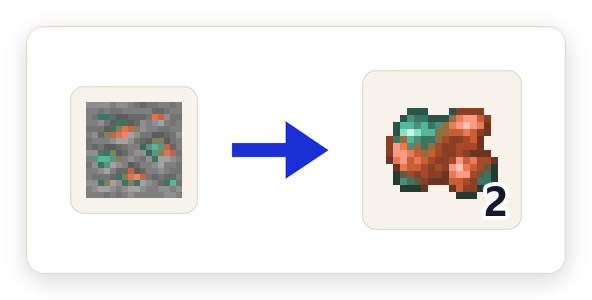
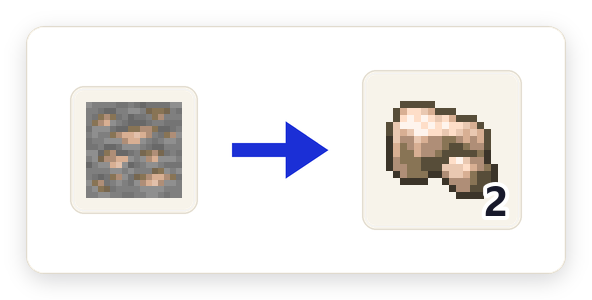
The parked build contains the framework and exactly one real machine to prove it works: a Machine Frame, a Steam Mill that turns one ore into two crushed ore, and a clearly labelled Dev Energy Cell that exists only so machines can be powered before generators are written. There are 17 unit tests and 12 in-game tests, all green. No grid, no cables, no generators, no eras.
🎒 Items & blocks
⚡
Steam Mill
The first and only finished machine. One ore in, two crushed ore out, 200 ticks, and the front face lights up while it works.
Where: Exists in the current framework build.
⚡
Machine Frame
The universal casing every Gridworks machine is built around. Does nothing on its own.
Where: Exists in the current framework build.
⚡
Dev Energy Cell
A one megajoule battery that shoves power into its neighbours so machines can be tested before generators exist. The word Dev in its name is the entire design document.
Where: Exists in the current framework build; intended to be deleted the moment a real boiler works.
⚡
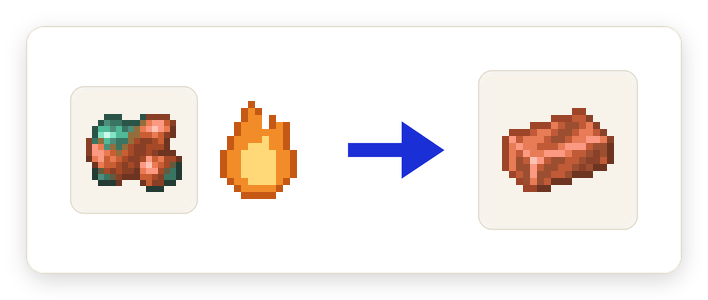
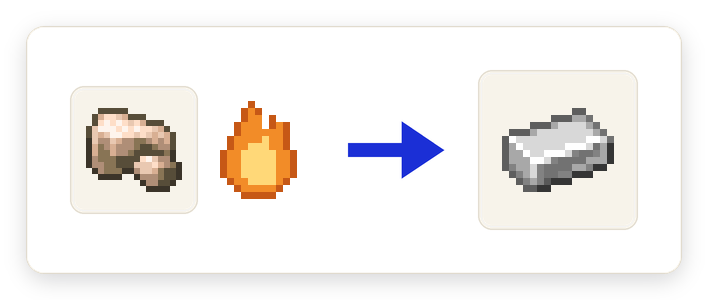
Crushed Iron and Crushed Copper
Steam Mill output. Each smelts or blasts back into an ingot, so milling genuinely doubles your ore.
Where: Run iron or copper ore through the Steam Mill.
⚡
Wrench
Registered, stacks to one, and currently does nothing at all. It is the creative tab icon.
Where: Exists in the current framework build.
⚡
Multimeter
Designed, not built. Point it at any cable or machine to read the network's supply, demand and spare headroom, and that machine's own draw.
Where: Planned for the electric era.
⚡
The Inserter
Designed, not built. A visible animated arm that lifts items between belts, machines and chests. Named in the design as the mod's screenshot machine.
Where: Planned for the electric era.
⚡
Foreman's Handbook
Designed, not built. An era-chaptered manual with draggable 3D multiblock previews that assemble themselves layer by layer, given free the first time you craft anything.
Where: Planned; opening it would grant an advancement called Read The Fine Manual.
📜 Lore
Flavour, not rules. None of this changes how the mod behaves.
Let there be watts
The design's central moment is not a boss or a dimension, it is a light bulb. You get steel, you get tar-derived insulation, you bolt a dynamo onto the steam engine you have been running all game, and the first watts in the world appear. The advancement is called First Light. Everything after that, cables, meters, brownouts and the whole grid, switches on at once.
Nothing is waste, it is just early
The tech tree's spine is a real historical pattern: the beehive coke oven burns off its tar and gas into the sky, and the by-product coke oven that replaces it captures them. Depleted uranium becomes armour plating and ballast. Scrap melts back into ingots in the arc furnace. There is an advancement chain named Nothing Wasted, and the mod's soft victory condition is a day where your grid ran entirely without fossil fuel.
🎁 Jokes & trivia
Bits you might miss
There is an advancement for turning the hand crank for five straight minutes. It is called Duty Cycle.
Putting a potato into the biogas digester gets you an advancement called It's Something.
Getting shocked by your own uninsulated overhead power line is an advancement called Grounded.
Opening the instruction manual grants Read The Fine Manual.
The auto-shutdown on the fission reactor is deterministic, has no random meltdown, and gives you an advancement called Safety Culture for using it.
The Dev Energy Cell is a placeholder battery whose entire design rationale is the word Dev being in its name.
The mod's startup log line promises "let there be watts (eventually)".
From the workshop
The standard Forge energy system stores its numbers in a type that caps out around two billion, and Gridworks was designed to reach gigajoules, so the internal ledger uses a much larger number type and only clamps down at the boundary where other mods look in.
A unit test walks the source tree and fails the build if a Forge import appears in the portable layers, in both directions. The payoff would have been a much cheaper port to NeoForge later.
Every texture in the existing build is a borrowed vanilla one, mostly the furnace front and an iron block. Art was scheduled to arrive one era at a time and never did.
The in-game test suite had to be moved to run in a temporary folder because cloud file sync kept locking the test world mid-save and crashing the test server.
An item duplication bug was found and fixed here: shift-clicking a machine's output into an almost-full inventory merged the stack without telling the machine, so the items came back after a reload.
An idle machine hands back no ticker at all rather than a cheap one, so a factory full of stopped machines costs the server nothing.
❓ FAQ
Can I download and play this?
No. There is no release. A jar exists on the author's machine but it contains one crushing machine and a debug battery, not a game.
Is it like Mekanism or Create?
That was the scale it was aiming for, with a spine neither of those has: real industrial history as the progression, and the power grid itself as a system you manage rather than a number.
Why did it stop?
Scope. The project ledger's own verdict is that spec-first systems mods stall when the design turns into bookkeeping before it turns into a moment.
Would it have punished me for running out of power?
Deliberately not. Undersupply only slows machines down, to a floor of quarter speed. No damage, no randomness, no explosions from mistakes.
Could it ever come back?
The framework, the tests and eight source-verified engineering reports are all still there, and the next milestone's starting instructions are written out. It is parked, not deleted.